
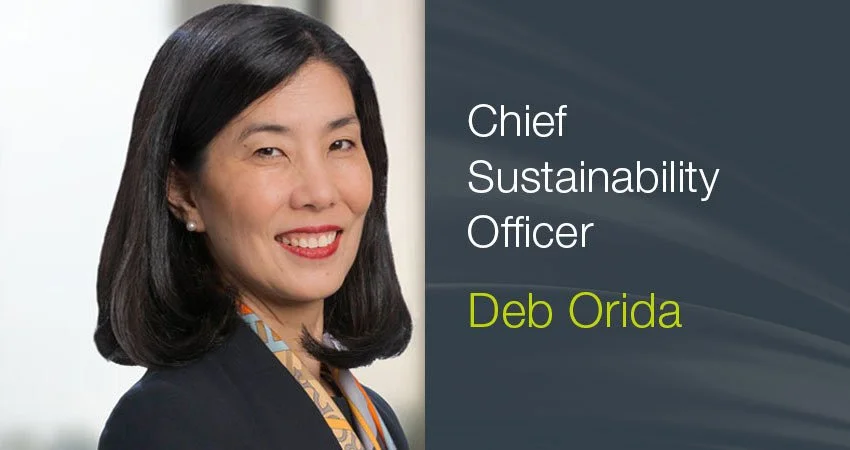
Deborah Orida Appointed as the First Chief Sustainability Officer (CSO) for CPP Investment
Deborah Orida is appointed as the first Chief Sustainability Officer (CSO) for CPP Investment. She is responsible for the approach to environmental, social and governance matters, particularly climate change.

Deborah Orida is appointed as the first Chief Sustainability Officer (CSO) for CPP Investment. She is responsible for the approach to environmental, social and governance matters, particularly climate change.

Media Training Success, JP Morgan Asset Management Story
Eddy Wong, Managing Director, JP Morgan, was the moderator in Business Mandarin at the HKIFA event on 30 Oct 2015. This event had 300 participants from Asset Managment giants, regulators, HKSAR govt, HKEX, SFC, public media and certainly industry players. Blackrock, Fidelity, Invesco, Schroder, Manulife, HSBC, Deutsche Bank, Standard Life, Principal, KPMG, PcW, EY... all were present.

Eddy Wong, Managing Director, JP Morgan, was the moderator in Business Mandarin at the HKIFA event on 30 Oct 2015. This event had 300 participants from Asset Management giants, regulators, HKSAR govt, HKEX, SFC, public media and certainly industry players. Blackrock, Fidelity, Invesco, Schroder, Manulife, HSBC, Deutsche Bank, Standard Life, Principal, KPMG, PcW, EY... all were present.
Although Eddy is not a native Mandarin speaker, he excels himself by committing in media coaching in Business Mandarin. At the HKIFA event, he facilitated an excellent conversation with the panel members - who are all native Mandarin speakers - from bank custodian, fund recognition lawyers, online fund sales, tech-finance, 020 and wealth management in the PRC.
Eddy committed 75 minutes per week for a high-impact coaching Media Business Mandarin coaching. Before the HKIFA event, he worked untill 1150pm to fine-tune his speech and overview the details of the flow of conversation, and understand deeply the speakers viewpoints. It paid off, and I am proud of him..

Background Story:
Eddy Wong has committed to a leadership communication coaching in Business Mandarin. Eddy is an excellent spokesman for JPMorgan for fund distribution in the PRC. He is building the JPMorgan brand, and positioning JPMorgan as the market leader in fund distribution and fund recognition.
You are the next one for a keynote speech in Mandarin Chinese. Connect Vienne Lee here at LinkedIn, or call 2895 1088, or viennelee@financemandarin.com
Course details: Mandarin Media Coaching


Mary Callahan Erdoes, J.P. Morgan's CEO of Asset & Wealth Management: Top 10 Themes That Will Define the Future of Asset and Wealth Management
Top 10 Themes That Will Define the Future of Asset and Wealth Management
1) Price
2) Scale is a matter of survival
3) Actively advising clients
4) Impact and purpose
Top 10 Themes That Will Define the Future of Asset and Wealth Management

J. Pierpont Morgan would be proud that many of the historical tenets of the asset- and wealth-management industry still form the bedrock of how money is managed in modern times. J.P. Morgan’s first investment fund was started in the late 1800s to serve British financiers wishing to invest in the emerging United States of America. The fund’s 150-year track record is a testament to our industry’s founding principle: While the world may change, clients’ desire for investment expertise and personalized service won’t.
With that in mind, here are 10 key themes that we look forward to helping our clients navigate in the future.
1) Price. Ever since I entered the asset-management industry, skeptics have warned that fee pressure will destroy profitability and detract top talent from the profession. Fees in every industry compress at some point. Successful firms of the future will thrive by either providing commodity-like products at scale for near-zero cost, or delivering hard-to-access insights and exposures that command a premium. Our industry must strive for continuous improvement on both ends of the spectrum.
2) Scale is a matter of survival. With compressed pricing, heavy regulatory controls, and immense spend on data, analytics, and risk-management tools, firms need a relentless focus on operational efficiency, a rigorous control framework, and a disciplined prioritization process around investments for the future. In this context, scale is key. Mergers and acquisitions and outsourcing of sub-scale and noncore capabilities to service providers will enable smaller firms to refocus their efforts back into their most important asset: talent.

JP Morgan Wholly-Owned Subsidiary in China Opened
3) Actively advising clients. If we learned anything from the Covid-19 crisis, it is the need for sound advice in volatile times. During that time, thousands of actively managed funds outperformed their passive alternatives across asset classes and portfolios. While markets may be efficient, manager selection is key and clients need guidance. The average industry return of a balanced portfolio over the past two decades was 6.4% annually, while the actual experience of the average retail investor was only 2.9%, a stark reminder of how critical hands-on advice is.
4) Impact and purpose. Portfolio managers and research analysts have become essential for investors seeking to make an impact in the world through their assets. Over 80% of surveyed CIOs expressed intent to invest in environmentally and socially conscious companies. Analyzing CEOs and their management teams is no longer just about inquiring about their financial and operational expertise and vision, but also about the impact they make on their communities and the planet. Rising demand for companies that drive positive change will create a virtuous cycle of asset allocation for good.
5) Personalization. Today’s investors want to be intentional, not passive, in investing. They care about taxes and want to overweight companies that can make a difference. They want to avoid whole sectors, or actively own and vote on a company’s strategic plans. Giving clients the freedom to pursue their very specific objectives in a highly customized manner will continue to drive innovation in our industry.

JPMorgan Asset Management MRF: 6th Mainland-HK Mutual Recognition Fund
6) Stable and predictable incomes. Millions of investors around the world have come to rely on their investment portfolios as a stable source of income. With individuals enjoying longer life spans and more active lifestyles, especially during retirement years, asset managers need to adapt their strategies to provide for a stable and predictable flow of income every month. Along the same lines, saving needs to start at a young age. Today, less than 40% of Americans have enough savings to pay for an unexpected $1,000 expense in cash. It is our collective responsibility to educate and advise on what is required to cover all of life’s events and milestones.
7) Understanding China. The pandemic has highlighted the interconnectivity of the world and how important China is to supply chains and new innovations. Against this backdrop, it is irresponsible to be a fiduciary of client capital and not have a deep understanding of places like China. It is hard to imagine having a true grasp of competitive global forces without on-the-ground insights of the economies, cultures, and politics of re-emerging global marketplaces. After 100 years of being on the ground in China, J.P. Morgan is poised to become the first foreign asset manager to acquire full ownership of a Chinese fund manager, pending regulatory approval. That kind of commitment will contribute massively to our global research network.

14th Five-Year Plan Insights: CBIRC - Real Estate - Grey Rhino with Greatest Financial Risk
8) Technology drives everything. To adapt to the velocity of progress and change, technology is providing our industry access, speed, and agility like never before. With more technologists than Google and Facebook combined, J.P. Morgan invests over $12 billion annually in technology to help empower our clients and employees to work faster and more seamlessly in ever-changing markets. We need to be forward thinking and have the ability to be a disruptor. Agile, collaborative partnerships between technologists and their businesses will drive innovation and speed to market at an exponential pace.
9) Access. With a global footprint and a full suite of investment vehicles, asset managers must continue to focus on enabling first-time investors to invest in previously inaccessible areas. We are finding ways to provide more opportunities, more choice, and more power to people. Investments once only available to the largest investors in the world are now being accessed by the everyday investor. Democratization of markets should create better outcomes for investors of all sizes.

10) A new flexibility. Our industry adapted quite seamlessly to a previously unimaginable work-from-home scenario. As such, increased flexibility will broaden talent pools and should promote greater diversity. While never losing the apprenticeship nature of our business, we should continue to find new ways of working with one another to generate even greater success.
In coming years, the industry’s winners will remain obsessed about their fiduciary responsibilities. As stewards of capital, the ability to leverage technology and scale to deliver the same extraordinary experience for every investor, with $100 or $100 million, is now within reach.
Book your Asset Management Certificate at Finance Mandarin
Talk to Vienne Lee
Find us via LinkedIn

6 Facts You Need To Learn About Xiaohongshu 小红书 | Learn Business Mandarin with Vienne Lee
What is 种草(seeding/grass plating), which is widely used by the Chinese on social media platforms?
Xiaohongshu IPO LIVE event on 4 June 2021, 9.30 a.m. They discussed the key leaders of Xiaohongshu, explored its business model and challenges. At Finance Mandarin, we provide the latest market insights and case studies to help corporate leaders master the Mandarin language skills, to prepare for Mandarin communication with Chinese clients.
Vienne Lee and Debbie Chen hosted a Xiaohongshu IPO LIVE event on 4 June 2021, 9.30 a.m. They discussed the key leaders of Xiaohongshu, explored its business model and challenges. At Finance Mandarin, we provide the latest market insights and case studies to help corporate leaders master the Mandarin language skills, to prepare for Mandarin communication with Chinese clients.
What is Xiaohongshu?
Xiaohongshu is an e-commerce (电商)and social media platform (社交平台)that allows users to share their product feedback and lifestyles. It has over 300 million users worldwide.
What is 种草?
种草 (seeding/grass plating) is a network term created on Xiaohongshu’s platform. It means to be influenced to purchase something. Hence, the consumer’s purchasing behavior is greatly influenced by KOLs and KOCs. This has created a large e-commerce and advertisement platform for Xiaohongshu.
By studying this case study, you will be able to:
✔️ Identify the listed capital of Xiaohongshu
✔️ Realize the investment from well-known institutions
✔️ Predict potential challenges
✔️ Analyze the competitiveness
Vienne has prepared 8 real case studies about Xiaohongshu. Learn more at Finance Mandarin.
Connect with Vienne Lee to book a course
Coaching Business Mandarin for Executive Leaders
You learn, you earn
“Hong Kong Bankers need to Speak Better Mandarin. That's Why they Come to me”
“If an interviewer at a bank in Hong Kong wants to find out how well you speak Chinese, they won’t ask you ‘how good is your Mandarin?’ They’ll just ask…
“If an interviewer at a bank in Hong Kong wants to find out how well you speak Chinese, they won’t ask you ‘how good is your Mandarin?’”, says Vienne Lee, director of language coaching company Business Mandarin. “They’ll just ask a normal question like ‘can you compare Tencent and Alibaba’s business models?’ and see how well you respond in Mandarin.”
Since setting up her company in the late 1990s, Lee has tasked herself with improving the Mandarin skills of some of Hong Kong’s leading bankers at firms such as J.P. Morgan, Goldman Sachs, Morgan Stanley, HSBC, UBS, and BlackRock.
Over the past year, as Western banks have cut jobs in Hong Kong and Chinese firms have increased their hiring, Lee has seen an uptick in unemployed financial professionals seeking assistance with their job searches.
“We’re also working with more bankers who are on gardening leave or are setting up their own hedge funds or family offices,” she says. “We polish their Mandarin communication skills for the finance sector, and coach them about building networks and interviewing.”
But Mandarin isn’t only important when you’re looking for work. Lee, whose firm focuses on financial services and mainly takes on clients at the VP level and above, helps bankers perform better on the job.
“I recently had an Australian client who was able to complete an opening presentation to 170 people in Chinese – it went extremely well, with applause in all the right places,” she says. “If you can go from nothing to making a speech to a Chinese audience, it also shows your colleagues and clients that you’re committed to doing business in China.”
Western finance professionals operating in China and living in Hong Kong – whether they are complete beginners or already know some Mandarin – make up about 60% of Lee’s students.
Another 20% are Cantonese-speaking Hongkongers whose written Chinese is good but who want to polish their Mandarin pronunciation. “Thirdly, we teach overseas-born Chinese who speak a bit of basic Mandarin at home, but can’t cut it in the Chinese financial world so need help with terminology in areas like due diligence, modeling, and valuation.”
Whatever their background, most bankers find learning Mandarin challenging. “Sometimes they don’t have enough time for classes and revision. And there’s the sheer volume of financial terminology and the difficult tones and grammar,” says Lee.
Understanding the Chinese Business Culture
She also helps Westerners adjust to the different presentation styles they will encounter in China. “For example, they often think it’s necessary to make a joke at the start of a speech and play themselves down,” explains Lee.
“But in China, you need to show people you’re the boss – especially if you’re presenting to them for the first time – otherwise they won’t look up to you as a role model. When we’re coaching people, we show them speeches from Chinese business and political leaders,” she adds.
The growing importance of Mandarin
Lee says she always had a “passion” for the Chinese language. After organizing financial conferences in 1998 – soon after China assumed sovereignty over Hong Kong – she realized that Mandarin would become increasingly important to banking careers in her city.
“The conferences connected me to more than 1,000 people in the finance sector. And I saw a gap in the market: bankers wanted presentation, pitching, and interviewing skills in Mandarin that were tailored to the technical needs of their jobs,” she says. “To secure Chinese deals, you need to understand China – both its language and its culture.”
Coaching Business Mandarin for Executive Leaders
You learn, you earn